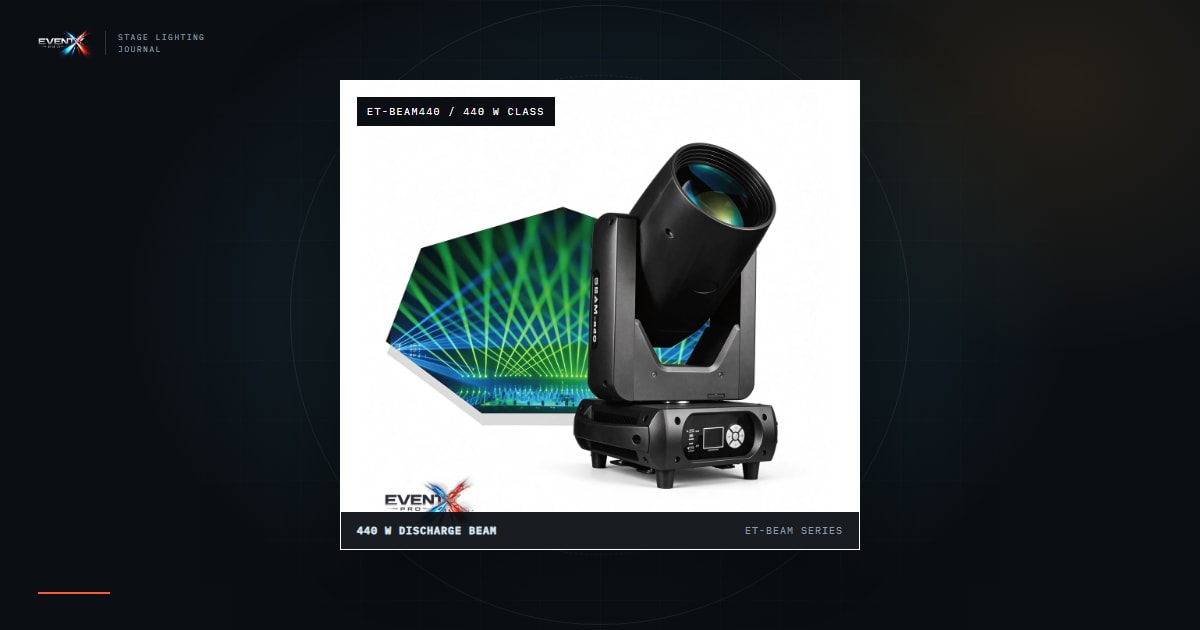
How to Choose a Beam Moving Head: Effects, Acceptance & RFQ
Ask five suppliers for a “300 W beam” and you will get five different fixtures. One will out-throw the others at 30 metres. One will have a tighter spot and a softer edge. One will cost twice as much to run over five years. The wattage on the box tells you almost nothing about which is which.
This guide covers the three decisions that decide whether a beam purchase works in service: the effect package, the acceptance test, and the questions you ask before the PO. If you are still choosing between beam, spot and wash, start with our category guide.
Read the wheels like an LD
A beam’s effect package is where manufacturers compete — and where spec-sheet counting replaces judgement. Fourteen colours and seventeen gobos mean little if the white is dim, the gobo edges are soft, or the prism has a dark seam.
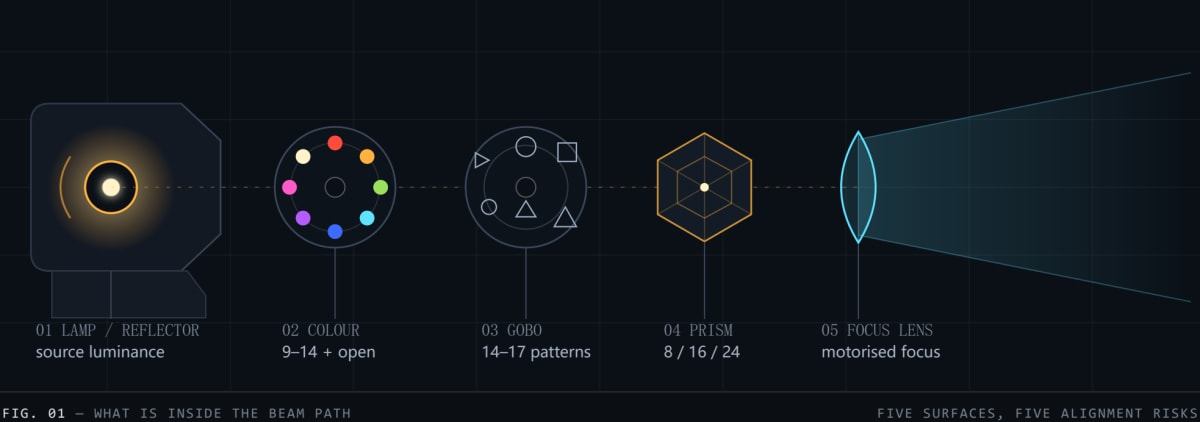
Fig. 01 — What is inside the beam path: five surfaces, five alignment risks.
- Colour wheel: 9–14 dichroic filters + open white, half-colour and rainbow. Check that open white is a true pass-through, not a coated “white” that costs output; check saturation and shift after 100 hours.
- Gobo wheel: 14–17 static patterns; metal for durability, glass for detail. Beam gobos are small and heat-loaded. Check focus at both ends and that jitter does not scrape.
- Prism: 8/16/24-facet or honeycomb, often two independent prisms. Good ones stack and rotate without a visible seam; cheap ones lose alignment. Test every facet.
- Frost & iris: frost softens the beam for a moment; an iris shrinks it without changing the lens. Useful, not essential.
- Focus & dimming: motorised focus is non-negotiable for varying throws. 16-bit dimming matters at the bottom; check camera flicker at 50%, 25% and 10%.
- What not to pay for: animation wheels, huge gobo counts and motorised zoom are not automatically better on a beam. Spend on focus, prism alignment and lamp access.
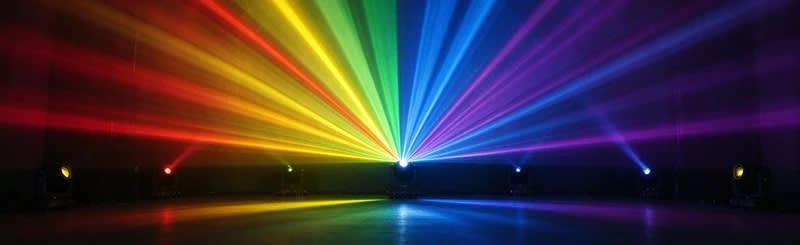
Colour: 14 dichroic + open, half-colour, 7-colour rainbow.
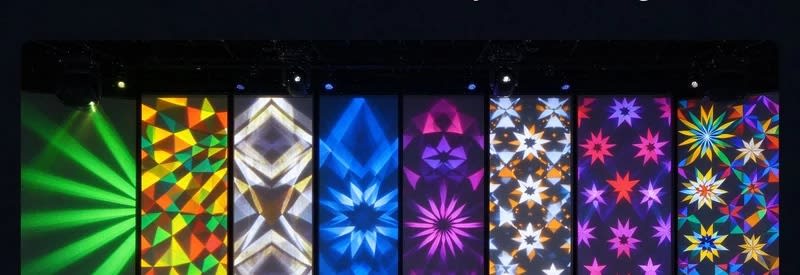
Gobo: 14 static patterns, focus and jitter.
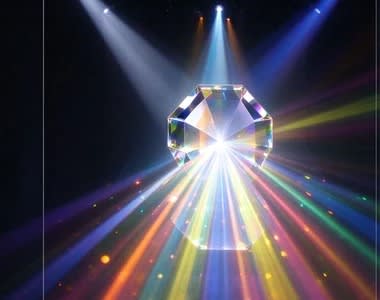
Prism: 8-facet + 8+16+24 honeycomb, independent rotation.
The 10-minute bench test: fixture on a table, lens 8–10 m from a white wall, every wheel through every slot, focus at both ends, listen to the fan and the motors. If a supplier will not let you do that before the PO, that is your answer.
Acceptance: test the shipment, not the brochure
A demo unit is not a shipment. Test the first article, then sample 10% of the PO — in a dark room, with a lux meter, not in a bright warehouse.
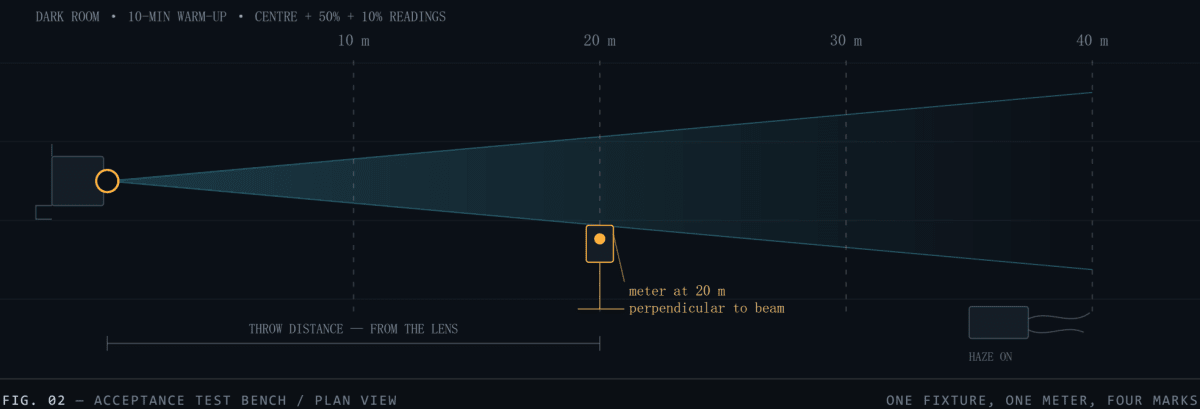
Fig. 02 — Acceptance test bench: one fixture, one meter, marks at 10–40 m.
- Packaging & cosmetics: no cracked covers, bent yoke or missing accessories; flight case fits.
- Lamp & alignment: correct lamp, fully seated, no hotspot; reset the lamp-hour counter.
- Power-up: display, fan, boot time and error log; voltage label matches the market.
- Pan / tilt: full 540°/270°, no mechanical noise; returns to mark after 20 moves and a power cycle.
- Beam quality: round, sharp edge, no halo or double image; focus at 10 m and 30 m.
- Colour wheel: every slot, half-colour and rainbow; no sticking, no shift at open white.
- Gobo wheel: every pattern, focus, rotation/index and jitter; no scraping or chipped gobos.
- Prism: every facet, rotation and stacking; no dark seam after a 2-hour soak.
- Dimming & strobe: 0–100% smooth, low-end control, flicker-free on camera at 50%, 25% and 10%.
- Thermal soak: two hours at full output: no derating, stable fan noise, sane housing temperature.
- DMX / RDM: address, channel map, RDM discovery, firmware version and termination.
- Photometrics: lux at 10/20/30 m within ±10% of published; beam diameter matches the formula.
Photometric verification: warm the fixture for 10 minutes, dim to full, hold the meter perpendicular at the same distance from the lens, and take the centre reading plus readings at 50% and 10% of peak to establish beam and field angle. A 10% shortfall may be a meter or a haze issue; a 30% shortfall is a conversation with the supplier.
- Pass: lux within ±10%, no mechanical noise, no alignment shift after the 2-hour soak.
- Investigate: 10–20% low, one noisy fan or one sticky gobo: open a unit, re-test, then decide.
- Reject the lot: more than 20% low, prism misalignment, cracked optics or missing certification.
The RFQ: ask questions that have numbers in the answer
Most beam RFQs ask for “best price for 300 W beam, 20 units”. That gives you a price and nothing to compare it with. Send these ten questions instead; the answers become the comparison table.
- What is the measured candela — or lux at 10/20/30/40 m — at which beam angle? Can you send an IES/LDT file?
- What is the actual beam angle range, and is it fixed or motorised?
- Which lamp exactly — manufacturer, model, wattage, life and colour temperature — and is it proprietary?
- What is the total power and current at 120 V and 230 V, and what is the inrush?
- What is the DMX channel map, does it support RDM, and how is firmware updated in the field?
- What is the IP rating, ambient operating range and dB(A) at 1 m?
- What is the weight, dimensions, rigging orientation and flight-case specification?
- What is the warranty, spare-parts policy and lead time for lamps, fans and PSUs?
- Which certifications (CE/UKCA/RoHS/ETL) and test reports can you provide?
- Can you supply two demo units for a two-week trial, with a service manual and DMX chart?
Questions 1 and 4 are the filter. If the supplier cannot answer them with numbers, the rest of the conversation is decoration.
A sensible fleet mix
- Clubs and ballrooms, 10–20 m: 230–295 W, 3.8–5°, 17–19 kg. Two per truss position is often enough; haze does the rest.
- Mid-size venues and festivals, 20–35 m: 295–380 W, 2.5–4°, 20–23 kg. The volume of the market for a reason.
- Arenas and outdoor stages, 35 m+: 380–440 W, 2–3.5°, IP65 if exposed. Buy fewer, brighter units; truck space and rigging time are real costs.
- High-utilisation venues: a 250 W LED beam for low maintenance; accept a shorter throw or a higher price for the same punch.
Score the answers
- Candela / lux: a number at a stated distance, plus an IES/LDT file. Red flag: “very bright” or wattage only.
- Lamp: manufacturer, model, life and colour temperature. Red flag: “equivalent 300 W” or proprietary.
- Power: amps at 120/230 V, inrush and power factor. Red flag: only “450 W”.
- Service: warranty, spares lead time, field firmware path. Red flag: “no problem” or no manual.
Two red flags is a no-bid. The cheapest quote is not the cheapest fixture.
Send us your longest throw. Tell us the room, the trim height and the look; we will come back with a beam angle, a wattage class and the numbers to compare — not just a price. eventxpro.net/contact · info@eventxpro.net
Sources: IES beam-angle definition; ANSI E1.20 (RDM); IEC 60529; Elation Professional; Prolights; EventX Pro.